He did not know who he was.
He did not know his own name.
He did not even know how he ended up drifting down the river.
—
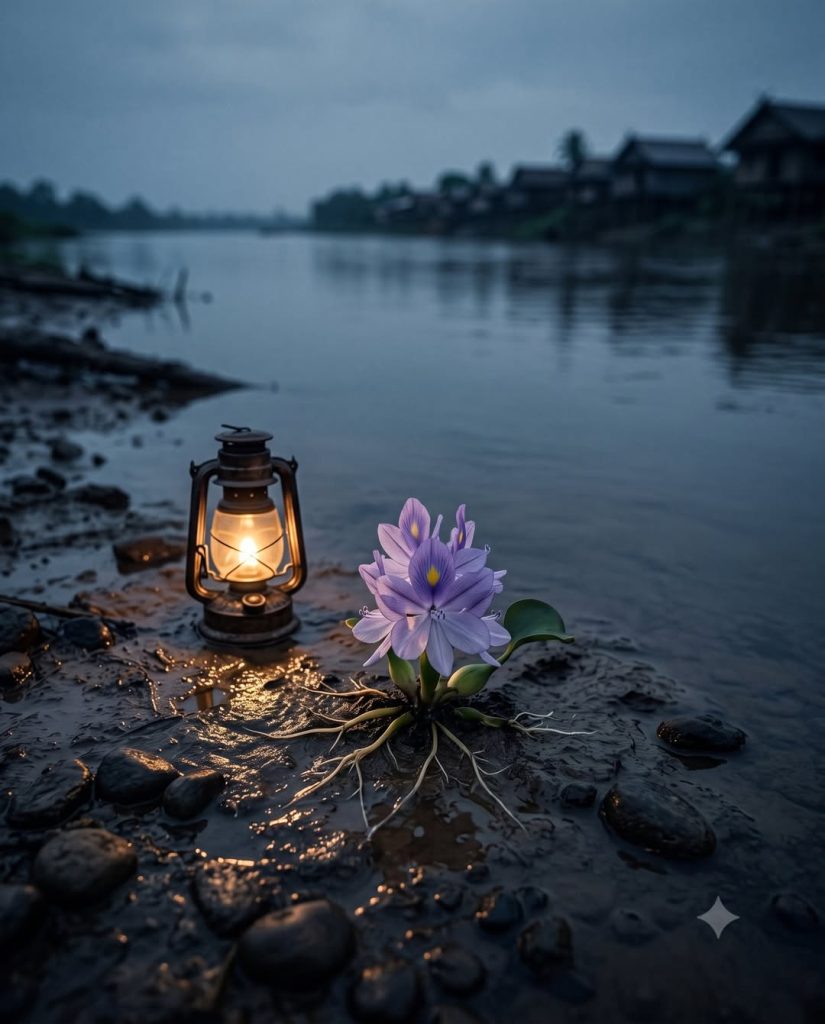
It was a night of torrential downpours when the Sittaung River swelled dangerously high. On nights like this, logs and firewood usually washed down with the current. That evening, a group of villagers salvaging floating wood spotted a human body trapped among the logs and pulled him out of the water.
The unconscious youth, appearing to be around nineteen years old, was carried to the village clinic. Though his body was covered in scrapes and bruises, his life was out of danger.
He woke up the next day. Yet — he did not know who he was. He did not know his name. He did not even know how he had ended up in the river.
With nowhere for him to go, a childless retired teacher couple agreed to take him in. Since he had drifted in from the water, they gave him the temporary name “Maung Bedar” (Water Hyacinth). The retired schoolmaster’s name was U Zaw Myo, and his wife, a retired teacher as well, was Daw Aye Mu.
Maung Bedar exhibited a few peculiar behaviors.
When darkness fell, he hated having lights on. “Turn off the light quickly… They’ll see us!” he would cry in terror, hiding himself in the dark.
When asked, “Who will see us, son? What happens if they do?” he could offer no answer. Only when he regained composure would he creep out of his hiding place. After a few days, he gradually accepted the lights again.
Then — the dreams began.
The first dream lacked a clear storyline. Around midnight, when Daw Aye Mu woke up for a drink of water, she found Maung Bedar sitting upright in bed, trembling violently. He was neither screaming nor crying — just staring with wide, terrified eyes.
“Son… what’s wrong?”
“My face was wrapped in cloth… my hands were tied behind my back, and I was thrown into the back of a truck, Mother. The truck was driving. I don’t know who they were. I don’t know where they were taking me. I couldn’t see anything. The smell of gasoline was suffocating.”
It was a dream without visuals. Yet the boy’s trembling hands made it clear that the sounds and smells were no mere figment of imagination. Worried, U Zaw Myo and Daw Aye Mu decided to take him back to the clinic.
The village doctor admitted, “I can’t tell if he suffered head trauma. I’d advise taking him to the city to see a psychiatrist.”
Going to the city required a vehicle, but no one in the village owned a car. There was, however, a single vehicle bought collectively by the village — which had been donated to the local monastery. Anyone needing transportation had to request permission from the head monk and fill the gas tank. Since the monastery attendant knew how to drive, it was customary to buy him treats as a token of gratitude whenever he drove.
“Venerable Sir, we would like to borrow the vehicle to take Maung Bedar to the city clinic.”
“The car is available, lay devotee, and it’s full of gas. But there is no driver. The attendant has taken ill and cannot get out of bed. Perhaps wait until he recovers?”
Just then —
“If there’s no driver, I can drive, Venerable Sir.”
Maung Bedar’s words caught even the head monk by surprise. “Oh? You know how to drive? Well, look at that! Here — try driving around the monastery compound first.”
The young man who did not know his own name handled the vehicle with remarkable skill. That day, the patient himself drove the party to the city clinic.
After examining him, the doctor called the guardians in to explain.
“I don’t see any physical head injury. His memory loss is likely due to experiencing a severe trauma. His subconscious mind forced him to bury those memories to protect his psyche.”
Seeing the blank, confused looks on their faces, the doctor rephrased it in simpler terms:
“To put it simply: your son isn’t insane. He went through something truly horrific. Because he couldn’t cope with it, his brain’s automatic defense mechanism forcibly erased it from his conscious mind. Fragments will start coming back through dreams and triggers. In time, he may remember on his own. But it’s also possible he never will. Please don’t force him to recall anything. Keep him feeling safe. Aside from love and care, there is no medicine for a condition like this.”
As he spoke, he wrote Dissociative Amnesia in the patient’s record book.
On their way out, no one spoke. Instead of returning straight to the village, they stopped at a falooda shop. The three of them sat together, sharing a bowl of falooda.
While eating, Daw Aye Mu whispered softly to U Zaw Myo, “Shall we tell him now?”
U Zaw Myo nodded gently.
She looked at Maung Bedar, who was quietly eating with his head bowed, and called softly, “Son.”
Maung Bedar looked up.
“Starting today, the two of us are adopting you as our own son.”
“Yes… Thank you — Mother.”
It was the very first time in Daw Aye Mu’s life that she had been called “Mother.” Tears welled in her eyes. In her heart, she made a quiet, firm vow: I will protect this child for the rest of my life, as best as I can.
At the time, no one realized how true the doctor’s words would prove to be.
The dreams were growing worse day by day.
—
Maung Bedar had traits that set him apart from the other villagers.
He could not bring himself to harm any living creature. He understood phone software and was remarkably skilled with computers. Yet whenever he tried to help with hard physical labor, blisters immediately formed on his hands. The retired teaching couple quietly took note of these details — their son must have grown up cherished and sheltered in a wealthy family.
Maung Bedar’s refusal to kill even a fish made him an oddity in the eyes of others. A frail youth who couldn’t even slaughter a fish, who woke up crying from nightmares in the middle of the night, and who stood far back on the shore, gazing at the river out of fear of the water — he was certainly not the typical youth of a fishing village.
Just as the doctor had warned, the nightmares grew progressively worse.
One night, Maung Bedar woke up startled again.
“In my dream, I wasn’t the only one tied up with my hands behind my back. There were many others. I was the youngest among them. Because I accidentally said I wanted to go home, they all kicked me… My molar broke.”
Drinking water as he spoke, Maung Bedar was breaking out in cold sweat from terror. Then — as if realizing something — he reached into his mouth to feel around.
His lower right molar was missing.
Silence fell over the house. Was this dream a reflection of reality?
Daw Aye Mu wept quietly. “My poor boy… what kind of horrors did you have to endure?” She squeezed his hand tightly and added, “No matter what you dream, you must tell me everything, alright? You don’t have to face this alone.”
As if testing that promise, a far worse nightmare came a few days later.
“Please, don’t do this! She’s just a child!”
A grief-stricken cry shattered the quiet night, startling the entire house awake. Unlike previous nights when he woke up in quiet panic, tonight Maung Bedar was screaming and sobbing uncontrollably.
When they switched on the light, he was already awake, drenched in sweat and weeping violently. Daw Aye Mu offered him water and gently coaxed him to open up, just as she had instructed. Gripping her hand tight, he recounted the dream through choked sobs.
Listening to him, a cold chill ran down the spines of both U Zaw Myo and Daw Aye Mu.
Somewhere deep in the forest. A group of men captured a young mother who was nursing her small baby. They demanded something from her. She refused, frantically pleading in fear and shame: “Please, Captain, I beg you. I come from a good family. Please don’t do this.” Unable to reach an agreement, they forcibly snatched the infant from her bosom.
“I couldn’t stop them… I was too terrified to even try. Right in front of my eyes… both mother and child…”
He could not finish the sentence before breaking into deep, wracking sobs. Daw Aye Mu wept alongside him; the horror was too much for her to bear. Please let such cruelty be nothing more than a nightmare. Please don’t let it be real, she prayed silently.
U Zaw Myo suppressed a heavy sigh. They realized that the trauma of helplessly witnessing others being brutalized had wounded the boy deeply. Even for U Zaw Myo and his wife, listening to it left an aching mark on their hearts. To think such suffering exists in this world… U Zaw Myo did not sleep that night.
—
The night of the final dream arrived.
This time, Maung Bedar did not scream. Just before dawn, he came to knock softly on Daw Aye Mu’s door himself. “Mother… I saw everything,” he said in a hushed voice, his face deathly pale.
“They dragged a young girl, barely fourteen years old, into the storm and tied her to a tree. At night, while they were high on drugs, I untied her ropes and told her to run quietly. But they caught on, and I had to run with her. A whole group chased us, shooting at us from behind. The girl was bleeding heavily. Realizing we had no way out, I grabbed her in my arms and jumped into the river.”
Maung Bedar paused, taking a deep, heavy breath.
“The moment we hit the water… she slipped from my grip. It was pitch black, so I couldn’t see a thing. The current was raging that night. No matter how frantically I searched… I couldn’t find her, Mother. That’s when I woke up.”
The doors to his memory were opening, one by one.
They noticed that no matter how terrifying the subsequent dreams were, Maung Bedar stopped crying as much. He was building resilience.
One day, Maung Bedar spoke up:
“Ever since that dream, I can’t stop thinking about the girl who jumped into the river with me, Mother. I feel like I failed her. I want to perform a deed of merit and share the blessings with her spirit.”
“Of course… let’s do that, my son.”
They offered a morning meal to the monks at the village monastery, donated a set of monastic robes, and offered prayers in the girl’s memory. Because they did not know her name, they could not dedicate the merit to her specifically — they could only visualize her face in their minds and chant, “May all beings near and far receive a share of this merit!”
That evening, Maung Bedar sat alone on the bank of the Sittaung River. He did not know who he was, what he wanted, or where he was headed. He simply stared at a single water hyacinth drifting quietly along the surface.
Watching from a distance, Daw Aye Mu felt a wave of sorrow. That night, she and U Zaw Myo engaged in a agonizing discussion. Should they help find his birth parents? Daw Aye Mu wept bitterly, unable to bear the thought of letting him go. In the end, though, she nodded in painful agreement.
The next morning, they took a photograph of Maung Bedar.
“We are caring for a young man who is suffering from amnesia. If you are his family, please contact us.”
They posted the picture on Facebook. Since the couple did not own an account, they asked Kyaw Swar, a local youth from the village, to post it for them.
Days passed. No one reached out. Daw Aye Mu felt a quiet, guilty sense of relief that no one had claimed him, feeling ashamed of her own selfishness. She kept reminding herself that Maung Bedar’s life was far more important than her own desires.
On the seventh day, a message arrived for Kyaw Swar.
It was not from his parents.
“I recognize the person in this photo. I don’t know who he is, but he saved my life. We ran for our lives in the dark and jumped into the river together. Please allow me to meet him once.”
Kyaw Swar rushed over to show the message to Daw Aye Mu.
The young girl who had jumped into the abyss with him — she was alive.
—
Two days later, the girl arrived.
She came accompanied by an elderly woman from a village further downstream. She was a thin, fragile girl with a faint scar visible near her nape.
She stood before Maung Bedar. He stared at her — a face so familiar, as if she had walked straight out of his dreams. Yet he still could not place who she was.
Tears spilled involuntarily down the girl’s cheeks. She had traveled a long way, passing through many villages, just to say one single phrase:
“Thank you.”
She recounted her story: after falling into the water, the rapid current carried her far downstream. She got caught in a thicket of bamboo at a river bend, where local fishermen spotted and rescued her early the next morning. The villagers tended to her injuries. Once she recovered, she desperately wanted to find the person who had saved her, terrified that he might not have survived. Then, she saw his face in Kyaw Swar’s Facebook post.
“My name is Hnin Ei.”
The girl whose name they had not known — whom they could not even name during their prayers — had a name now. And she was alive.
Maung Bedar collapsed to his knees right where he stood, covering his face with both hands, his shoulders trembling violently.
I couldn’t save her. The crushing weight he had carried for so long was lifted in an instant.
Just as the doctor had predicted, the barrier locking away his consciousness shattered completely. The night he was snatched. The darkness inside the truck. His broken molar. Everything he had witnessed. The escape. The cliff. The water. And — his entire life before all of it.
When Daw Aye Mu rushed forward to embrace him, Maung Bedar spoke through shaking, tear-choked words:
“Mother… I remember everything. My name… my name is Thiha, Mother.”
Standing nearby, Hnin Ei wept as well. The savior and the survivor — both had spent months carrying the agonizing belief that the other had perished.
—
At the dinner table that night, Thiha shared the story of his past.
He spoke of his parents in the city. Of passing his high school matriculation exams with four distinctions. Of his father, who had promised to buy him a car but broke his promise, saying he was “too young.” Of his mother, who tried to make amends by buying him a brand-new iPhone. Of the day he threw the phone away in anger and stormed out of the house. He hadn’t eaten all day, sitting on a brick wall at the head of the lane until darkness fell.
That night.
As twilight settled, a car pulled up in front of him. Men stepped out, wrapped his face in cloth, and forced him inside. From that moment until he reached this village, everything lived only in his nightmares.
“The night I threw a tantrum over a material thing… turned out to be the night I lost my entire life, Mother.”
Daw Aye Mu held her son’s hand, her own fingers trembling. He remembered his real parents’ phone number now. She had to call. She should call. But if she did —
Wiping her tears unnoticed, Daw Aye Mu gently placed her phone into his hand.
“Call them, my son. As a mother who knows the pain of losing a child, I can understand what she must be going through.”
An elderly woman’s voice answered from the receiver.
“Mother… it’s me, Thiha,” he said softly.
Silence gripped the line for a long moment. Then came the sound of stifled sobs. Neither side could speak, holding the phone in heavy silence. Standing beside him, Daw Aye Mu wept tears of mixed sorrow and joy.
—
Before the night was over, Hnin Ei’s story had spread across the entire village.
The gentle boy who couldn’t bring himself to kill a fish, who struggled with hard labor, who woke up crying from nightmares — had risked his life to save another human being.
Two days later —
A fine car pulled into the village. The villagers gathered around to watch as it navigated the narrow paths, stopping right in front of U Zaw Myo’s house. A well-dressed man and woman hurried out of the vehicle and rushed to embrace Thiha.
“Thiha, my son… Thank goodness you’re alive!”
Thiha held his parents tightly, weeping for a long time. The mother’s cries of relief at finding her lost son echoed through the village.
When their tears began to dry, his father said, “Son… let’s go home. I’ve already bought you a new car. It’s yours.”
His father pointed toward the large vehicle — the very object he had once yearned for, the trigger that had derailed his life.
Thiha gazed at the car for a long moment before slowly turning around.
By the doorway stood Daw Aye Mu, sobbing quietly while U Zaw Myo wrapped an arm around her shoulders in comfort. Though she knew she ought to feel happy for his family, the pain of losing him was overwhelming.
Thiha walked past his birth parents and knelt deeply at Daw Aye Mu’s feet. She could say nothing, her tears flowing freely.
“I won’t give back the name you gave me — Maung Bedar. After all… I have two mothers now.”
Hearing those words, Thiha’s birth mother walked over to Daw Aye Mu and took her hands in hers.
“I don’t even know how to repay you for giving my son back to me,” she said through her tears.
Daw Aye Mu shook her head. “There is no debt to repay… This child gave us the gift of being parents.”
—
That day, Thiha returned to the city with his biological parents. Yet he frequently drove his new car back to the village, always bringing his parents along. Sometimes, Hnin Ei from the downstream village joined them too.
With every visit, he brought medicine for Daw Aye Mu and books for U Zaw Myo. Thiha’s father arranged educational sponsorships for ten underprivileged children in the village and funded the construction of a local library.
Since Hnin Ei had been forced to drop out of school, Thiha’s father provided her with full financial support so she could resume her education.
The villagers never called him Thiha. To them, he remained “Maung Bedar.” And whenever he heard it, he simply accepted the name with a warm smile.
A single water hyacinth, drifting along the surface, had once found a quiet place to rest in this little village.