The moment the news broke that Mya Gyi had been conscripted as a forced porter, everyone was thoroughly shaken. They said he was caught by a military truck late at night when he stepped out to buy medicine for his sick little boy. The question that instantly flashed through everyone’s mind was: How will his four-year-old son, little Bong Gyi, survive all alone?
—
Everyone in this village knew Mya Gyi. He was always filthy, dressed in tattered rags, and perpetually drunk. No parents, no relatives—a lone wolf. Sometimes he slept on a concrete bench; other times he passed out in a roadside gutter. When hunger struck, he would wander over to the local market looking for odd jobs.
“Carry this,” and he’d carry it. “Deliver that,” and he’d deliver it. “Haul this load,” and he’d haul it.
Yet, no one had ever heard of him stealing or cheating.
Of course, once he had been drinking and fell into a dead stupor, you couldn’t get him to move even if you offered him ten million kyats.
So when a guy like him managed to get married, the whole village was utterly astonished. Before anyone had even set eyes on his bride, they were already feeling sorry for her.
And they had good reason to. His wife, Aye Bong, had never tasted a single bite earned by her husband since the day they wed. She had to toil in the fields—transplanting and pulling paddy seedlings—just to feed him. As mealtimes approached, she would have to hunt through the village gutters to find out which ditch her husband was sleeping in. When he mumbled that he couldn’t walk back home, she would dish out a plate of rice, climb down into the ditch, and hand-feed him herself.
When a heavily pregnant Aye Bong went into labor, it was the men from the trishaw stand who pooled their money to rush her to the hospital free of charge. Mya Gyi was nowhere to be found, dead to the world in some unknown ditch or on a random concrete bench.
Aye Bong gave birth to a baby boy at the hospital, but she passed away right there during postpartum recovery. Perhaps the grueling physical labor she endured during her advanced pregnancy had finally caught up with her. When a still-tipsy Mya Gyi finally stumbled into the hospital, Aye Bong could only utter her very last words in a faint, trembling whisper: “Please take care of our little boy, Ko Mya Gyi… You’re the only one left in this world I can rely on.”
Mya Gyi was shattered. In an instant, every trace of drunkenness vanished.
That tiny, reddish newborn bundled in swaddling clothes—who hadn’t even opened his eyes yet—completely transformed a man’s life.
From that day on, Mya Gyi quit drinking cold turkey. Long before dawn broke, he would bundle the baby in cloth and carry him along. He hauled whatever loads needed carrying at the market, doing every job assigned to him with utter respect and diligence. As for the trishaw drivers at the stand, it was their karmic duty, too—they took turns holding and soothing the baby. Since the wife of Ko Zaw Gyi, one of the drivers, was nursing a baby of her own, she fed the little boy her own milk as well.
The men at the trishaw stand gathered and named the boy “Bong Gyi.” They didn’t name him that simply because he was the son of Aye Bong and Mya Gyi; rather, it was a half-joking, affectionate jab because the whole community (Bong also meaning ‘collective’) had unexpectedly taken on the collective burden of raising him.
The trishaw drivers pooled their daily earnings to buy tins of powdered milk and warm swaddling clothes for him.
—
That was why the moment news broke that Mya Gyi had been taken as a porter, everyone was so deeply shaken.
When I arrived at Mya Gyi’s house, Ko Zaw Gyi the trishaw driver was sitting with Bong Gyi on his lap, feeding him snacks. We exchanged silent, heavy glances, implicitly asking one another: What on earth are we going to do now? Little Bong Gyi didn’t even know yet that his father had been taken.
From that day forward, no one could coax Bong Gyi out of that house; he insisted on waiting right there for his father to return from work. The trishaw drivers took turns staying overnight with him, and the villagers rotated bringing him meals.
Constantly crying for his father, refusing to eat or sleep, the boy eventually fell ill. Before long, he was bedridden. Everyone tried every avenue possible, but no one could establish any contact with Mya Gyi.
It reached a point where the boy’s life was genuinely in danger if things continued this way. When Bong Gyi saw me, he reached out, clutched my hand weakly, and asked, “Uncle Kyaw, is my daddy coming home soon?” Refusing food and sleep, little Bong Gyi couldn’t even walk anymore and lay motionless in bed.
About three weeks later, word finally came from Mya Gyi.
He had been forcibly conscripted into the military. Driven by desperate worry for his child, he killed his training instructor and escaped. He was now hiding out in an anti-junta controlled area, joining the PDF (People’s Defense Force). He missed his son desperately, but with scores of soldiers hunting him down, returning to the village was impossible.
Immediately, everyone gathered at the trishaw stand to hold an emergency meeting. Unanimously, they agreed: they had to get Bong Gyi to his father.
The real hurdle was the journey. No public buses ran to where Mya Gyi was currently hiding—a distance of nearly a thousand miles. Even if buses did run, Bong Gyi was lying bedridden from severe exhaustion and was in no condition to survive a rough public transit ride.
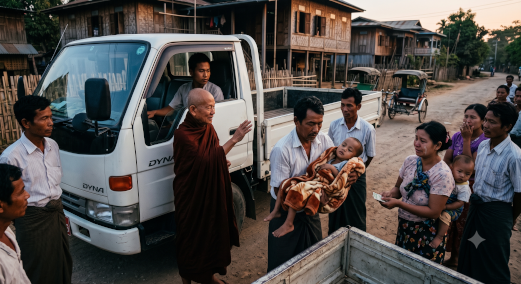
While everyone stood helpless and uncertain, the head monk from the village monastery arrived and offered his own Dyna truck. “The monastery attendant knows how to drive. Take him, fill up the tank, and go, lay devotees,” the monk said. “If little Bong Gyi can be reunited with his father, that is all the blessing I need.”
With a truck and a driver secured, the next challenge was raising money for fuel.
Ko Zaw Gyi’s wife came forward and handed over 55,000 kyats. “I’ve been saving 5,000 a week to buy myself a phone,” she said. “If little Bong Gyi can see his father again, I don’t care if I never own a phone. Use this for fuel.” The rest of the trishaw drivers pulled out whatever savings they had tucked away to contribute to the gas money. I personally contributed the 25,000 kyats I was supposed to pay off at the local liquor shop, putting it straight into the fuel fund instead.
We gently picked up little Bong Gyi, who was barely conscious and breathing faintly, and carried him onto the truck. As the vehicle pulled away, everyone gathered to bid him farewell. Ko Zaw Gyi’s wife wept uncontrollably—after all, he was the child she had nursed and raised alongside her own.
Because the area where Mya Gyi was hiding had no mobile reception or internet, getting word to him in advance was impossible.
Three days later, the driver returned.
He brought back a video clip of Mya Gyi and little Bong Gyi holding each other in a fierce, tearful embrace. Captured on a cheap phone camera in dim lighting, that grainy footage brought tears to the eyes of the hardened men at the trishaw stand.
That night, the celebratory drink didn’t take place at the local tavern. It was held right beside Aye Bong’s grave.
We raised our glasses toward her resting place and whispered softly, “We may be poor, Aye Bong… but we made sure your little boy grew up surrounded by love and kindness.”