He Couldn’t Afford Two Eggs. What Happened Next Restored Faith in Humanity.
The heavy downpour that afternoon had halted all work at the construction site. U Aye, a veteran mason, spent hours waiting for the rain to clear while eating his packed lunch, only to be sent home early. There was no work, which meant no daily wage.
He remembered his wife’s words from that morning: “If you get paid today, please bring back some meat for dinner.”
He reached into his pocket. All he had left was 1,200 Kyats—just enough for his bus fare home. Since it was still early, U Aye made a quiet decision: he would skip the bus and walk the long way home. He would use his bus money to buy eggs instead.
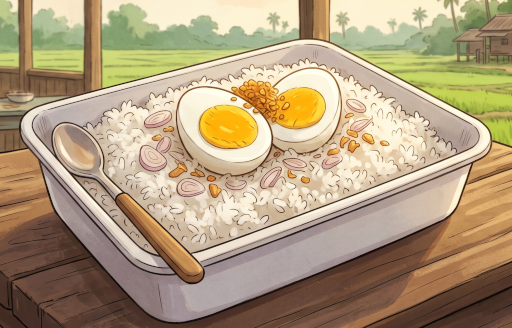
1,200 Kyats should be enough for two eggs, he thought. My wife can curry them with oil. We can cut each egg in half—one portion for me, my wife, and our two boys. With some fermented fish paste and fresh greens, it will be a decent meal for the family.
He walked into the local market and stopped in front of an egg vendor.
“I’d like two eggs, please. How much are they?” he asked.
“700 Kyats each. That’s 1,400 for two,” the vendor replied, holding out a small plastic bag with two eggs inside.
U Aye froze. He stared blankly at the 1,200 Kyats in his calloused hand. The vendor held the plastic bag suspended in the air between them.
“I’m… I’m sorry,” U Aye muttered softly, swallowing his pride. “I don’t have enough money. I can’t take them.”
He turned around abruptly and walked away. A heavy wave of embarrassment and inadequacy washed over him. What kind of father am I, unable to even buy two simple eggs for my family? Each step home felt heavier than the last.
“Uncle! Excuse me, Uncle!” a voice called out behind him.
He turned to see a young woman in her early twenties running toward him, holding a small plastic bag with two eggs.
“My mother asked me to buy duck eggs, but I accidentally bought chicken eggs instead,” she said, slightly out of breath. “I paid 1,400 Kyats for these two. Could you please buy them from me for just 1,000 Kyats?”
U Aye’s heart leaped with relief, but he hesitated. Could it really be such a coincidence?
Skeptical, he looked closely into her eyes. The young woman looked back at him without flinching. In her quiet gaze, there was an unspoken understanding—a gentle dignity that needed no explanation. U Aye heard it clearly. For a few long seconds, their eyes met in complete silence.
Slowly, U Aye let out a deep breath and looked away.
“Alright, young lady. I’ll take them for 1,000 Kyats.”
A bright, genuine smile crossed the girl’s face. “Thank you so much, Uncle!”
The trade was made. With his remaining 200 Kyats, U Aye stopped by a small roadside stall and bought a couple of candies for his two sons.
That evening, the warm, savory aroma of egg curry filled the modest house. U Aye switched on the small television in the living room. On state TV, a political interview was airing.
The official on screen spoke grandly: “If only our citizens work hard enough, there is no reason our nation cannot prosper.”
“Nonsense!” U Aye muttered under his breath, cursing quietly at the screen. He quickly snapped the TV off, suddenly worried his sons might hear him. He glanced nervously toward their room, but the two boys were quietly studying at their desks.
Just then, his wife called out from the kitchen. “Dinner is ready! If anyone’s hungry, come eat! You’ll get half an egg each with fish paste and boiled greens. I’m running out to buy a mosquito coil. If you want to wait for me, we can eat together when I get back.”
U Aye went to sit on the small porch outside. As he sat in the evening cool, a woman and a young girl stopped in front of his gate.
“Uncle…” the woman said softly. “We are displaced war refugees. Our entire village was burned down, and we fled here. Do you happen to have any leftover rice or food to spare?”
U Aye hesitated. The honest response would be to tell them that his own family barely had enough for tonight. But then he looked down at the little girl. She couldn’t have been more than eight years old, with sun-bleached reddish hair and a neat, polite demeanor.
When her eyes met his, U Aye felt a sharp ache in his chest. A child her age shouldn’t be begging for food, he thought. She should be sitting inside a warm room, studying her books and waiting to be called for dinner, just like my sons.
“We have rice,” U Aye said gently. “But for curry, we only have fish paste and boiled vegetables, my child.”
“That’s more than enough, Uncle. We can eat that,” the little girl replied, nodding earnestly.
“Wait right here for a moment,” U Aye said, stepping back inside the house.
He opened the rice cooker. His wife always cooked extra rice to fry for breakfast the next morning, so there was plenty. He found an empty container and packed a generous portion of rice. He poured a rich spoonful of fermented fish paste on the side and piled cooked water spinach, cucumber slices, and acacia leaves in the center.
He put the lid on, but then his eyes fell upon the curry pot. He paused.
Taking a deep breath, he opened the container again and lifted the lid of the curry pot. Inside lay four neatly halved pieces of egg in rich gravy. Without another thought, he scooped out one half of an egg, along with some gravy, and placed it on top of the rice.
As he carried the food back to the front door, his arm accidentally brushed against a stainless-steel plate, sending it clattering to the floor. The noise shattered the quiet, and his sons’ chanting of their school lessons suddenly stopped.
U Aye walked outside and handed the warm meal to the mother and daughter. “Take the container with you, my child,” he said softly.
The mother and daughter pressed their hands together in a gesture of deep gratitude and walked away into the fading light.
When U Aye stepped back inside, he saw his two sons standing near their room, having watched the entire interaction in silence. Moments later, his wife returned with the mosquito coils.
“Let’s eat, dear!” she called out.
“You go ahead with the boys,” U Aye replied quietly. “I’m not very hungry yet. Just save me some fish paste and boiled greens.”
His wife walked into the kitchen to serve the food. A few minutes later, his youngest son walked out to the porch.
“Dad, Mom says you have to come eat now. She already set your plate.”
U Aye walked over to the small dining table. There, waiting for him, was a freshly served plate of rice.
And right in the middle of his plate lay three small pieces of egg.
His wife and two sons had each cut off a third of their own small portion of egg and placed it onto his plate.
As U Aye stared at his plate in disbelief, all three of them looked at him with warm, gentle smiles.